Measuring Public Health with the Barometer
Download as PDF
Cite as: Stowasser, Jürgen (2025): Measuring Public Health with the Barometer (Madrid 1737). https://ilinx.at/posts/madrid1737.php.
[S]iguiendo el exemplo de las demás Academias de la Europa [..] el documento mas eficaz para los Literatos de otras Facultades, que contentos con las tinieblas de la antigüedad, desprecian las luces de la propria observacion, y experiencia.
In March 1737, the Madrilenian Royal Academy of Medicine (Real Academia Médica Matritense), founded only four years earlierThe foundation charter, published in 1734, declared as prime objective the nation-wide promotion and advancement of science and science-based medicine. Importantly in the political environment of the period, the charter document includes an address of support of the political authorities and church dignitaries (Academia Médica Matritense 1734: 20-22). The early period of the Spanish academies of science and medicine was shaped by shutdowns, resurrections, and political interference (e.g., a change of trajectories when a new monarch came into power). For the convoluted history of organizational reshuffles and frequent name changes see López Tárraga et al., 2020, and RANME 2025: 18f.; Eva Velasco Moreno discusses the foundation of academies in the context of the Novatores movement, the driver of the early Spanish Enlightenment (Velasco Moreno 2000), launched a research project in the city of Madrid to study the effect of climate and its seasonal fluctuations on public health. The academy published monthly reports titled Ephemerides barométrico-médicas matritenses (from now on: Eph-M), providing meteorological data and an epidemiological account authored by Francisco Fernández Navarrete, initiator and director of the project. Fernández Navarrete was an obvious choice for this task since he conducted the first instrumental meteorological observations in Spain.From 1706 on, he collected weather observations together with medical records in Granada (published in Fernández Navarrete 1997), where he held the chair in medicine at the local university (Gil Albarracín 2018). In 1728, he began to use an "English barometer" and a "Florentine thermometer" (Rodrigo 2019: 652f) and produced records of sufficient quality to be converted into a climatological dataset (see the detailed discussion in Rodrigo/Barriendos 1998).
Francisco Fernández Navarrete had spent the better part of his academic career at the University of Granada, first as a student of medicine and then as a faculty member taking the regular career path of holding first the less prestigious (and poorly paid) professorship called cátedra de Vísperas until being appointed to the prime Chair of Medicine (cátedra de Prima).Gil Albarracín (RAH): «Fernández Navarrete». In 1733, he was appointed \textit{médico supernumerario de Cámara} meaning he was now a court physician and part of the medical team of Philip V in the capital.See Gil Albarracín, op. cit. (For more on Fernández Navarrete's years at the University of Granada and his medical writings see my post \url{https://ilinx.at/posts/read-like-an-inquisitor.php} which outlines some of the particular challenges sources from early modern Spain pose for the history of science.)
An Ambitious Launch
The Ephemerides Barometrico-Medicas Matritenses were released as monthly reports, starting in March 1737 (see the title page of the first issue: Figure 3). Introduced as a long-term research endeavor, the Eph-M were discontinued with the October issue, following an apparently tumultuous period with two leadership changes. However, instrumental observations continued at least until December, possibly even longer (see below). The Eph-M have, quite uniquely, an "alter ego": a digest of three monthly Eph-M issues at once, published anonymouslyGarcía de Cortázar 2023: 245 argues convincingly that the author of the first two articles was almost certainly Fernández Navarrete himself. A look into the nondigitized part of Fernández Navarrete's manuscripts may help to further clarify this question. in the Diario de los literatos de España (from now on: Diario), a quarterly magazine dedicated to the promotion of scientific progress and the ideas of the early Enlightenment (racionalismo ilustrado). The articles in the Diario are presented as a mere summary of the Eph-M monthlies, they include, however, a few passages of additional content not to be found in the original. Another noticeable difference is the style of the digest, which is distinctly less deferential than the manner of writing in the Eph-M. Due to the entanglement of the two texts, I will do a parallel reading, treating the Diario digests as a second layer of the "official" version.
Two of the monthly issues, at the start of the Eph-M and then again in the September issue when a new project director took over, were presented with an introduction providing background information on the goals and scope of the project, the institutional setting, the equipment and the theoretical approach. In the introductions, we can observe the Diario version to diverge significantly from the original Eph-M. The main "empirical" part of the Eph-M has the same structure through all installments: Each monthly edition begins with the instrumental measurements in tabular form (see Fig. 4). The text then proceeds to a summary of the prevalent weather conditions and reports extraordinary events observed in the sky during the month (this includes meterological as well as astronomical phenomena in the present systematics). The following segment provides an epidemiological report with some case examples after which the monthly concludes with a description of anomalous findings in postmortem examinations (malformations of organs, weirdly colored tissue, etc.).
Empirical approach When Fernández Navarrete is describing the methodological approach of the Eph-M, he uses a vocabulary that plays on the chords of the empiricist philosophers of that time, e.g., «el mas exacto calculo»Eph-M: [iii], «observaciones Medicas», or «experimentos Physicos»---all of which may sound quite unremarkable to current readers but in the context of 18th century Spain's academic landscape this means to take a stand against the prevalent Scholasticism (and from a Scholastic's view, this is clearly the language of the reprehensible novatores). As the introduction states, this is also the general position of the Academy of Medicine: «La Real Academia Matritense, se ha propuesto desde el principio de su fundacion por fin primario, é idéa principal de su instituto, conducir la Medicina Española al termino de la mas possible perfeccion, por el camino de la observacion, y experiencia, imitando aquellos passos, y siguiendo aquellos rumbos, que gloriosamente han emprendido las Academias eruditas de la Europa [...].»Eph-M: [2] (Since its foundation, the Royal Madrilenian Academy has pursued the ultimate goal and central idea of guiding the Spanish medicine to the most possible perfection by means of observation and experimentation, thus reproducing the steps and following the course gloriously taken by Europe's learned academies.) From the perspective of the history of medicine, this explicitly more empirical approach resembles---and was likely inspired by---the work of Thomas Sydenham (Observationes Medicae, 1676).Fernández Navarrete makes no mention of Sydenham in the Eph-M, but he was familiar with the writings of his English colleague as his excerpts show. He refers to Sydenham, for instance, in a couple of notes headed Pro Arte Observatoria, Fernández Navarrete 1745: [232r]
Geographical scope Although initially limited to Madrid, the observations were intended to eventually cover the entire country (it is not clear if they planned to also include the oversea colonies). Contributors, for example, physicians and scholars, were expected to work on a voluntary basis.Eph-M: [iii] The same model appeared to already be in place to collect instrumental measurements and medical statistics in Madrid. Fernández Navarrete, however, does not provide any information on the particulars of the data collection (e.g., who participated, did the medical records cover the entire city or only some hospitals, etc.), just that he was in charge to "extract" the informations.Eph-M: [ii]
Place The central proposition is the entanglement of the human body with the territory and, thereby, the local climate. The health of the population of Madrid is intrinsically related to what Fernández Navarrete calls (in accordance with early modern usage) the "natural history" of a place.«Y siendo tan estrecha la unión entre la Medicina de un País, y la Historia Natural de él [..].» (Eph-M: [2f]) He therefore describes the whole undertaking of the Ephemerides as «Proyecto de la Historia Natural y Medica de España [..].»Eph-M: [3) The underlying assumption for the interconnection between body and place is the familiar notion of microcosm/macrocosm. The "preservation and transformation of our bodies," he explains in the introduction, "is characteristic and peculiar to each territory and country which is why people do not hesitate to speak of their very own sky."«[...] conservacion, y alteracion de nuestros cuerpos es tan propio, y peculiar de cada territorio, y País, que por él no dudaron los hombres llamarle Cielo propio de ellos.» (Eph-M: v) The preservation of the body as microcosm («nuestro cuerpo, como mundo menor») is entirely reliant on the events in the atmosphere as macrocosm which is why physicians have to conduct a combined observation of both medical and aerial phenomena («Phenomenos Meteoricos»).«La que desde luego ofrece por si la convinada observacion de los Phenomenos Meteoricos, y Médicos, está a la vista de quien huviere saludado las primeras Reglas de la Medicina practica, y aun de la razón natural. Sus primeros Legisladores vocearon la mutua dependencia, y consonancia entre la Atmosphera, sus condiciones, y mudanzas, y el estado, y alteraciones de nuestro cuerpo, como mundo menor, cuya conservacion en el todo depende del mayor.» (Eph-M: [4])
Air Most decisive for the well-being of Madrid's residents was, according to Fernández Navarrete, the air they breathe: «Es el ayre el pasto mas preciso, y mas continuo de nuestra vida. Es un Oceano donde la infinita variedad de cuerpos del universo, atenuados, y divididos se pierden, y ocultan en las ondas de la transparencia.»Eph-M: [4] (Air is the most essential and steady aliment of our life. It is an ocean in which the infinite variety of bodies in the universe are diluted and divided to disperse and hide in waves of transparency.) Here and in the following passage, he is drawing on Aristotelian notions such as air being the product of "exhalations" of the material world or the idea of the fifth element aether as the constituent of the upper celestial spheres.Eph-M: [4f]; Aristotle elaborated these concepts in the Meteorologica, see specifically Meteor. lib. I,iii on the celestial spheres and there the passage on the notion of the fifth element aether (Aristotle 1952: 13f) The reverting to Aristotelian tropes is somewhat at odds with the pledge to a strictly empirical approach and among several inconsistencies to be found in the Eph-M. Likewise, the reports on the diseases do not provide any case numbers, in spite of the declared intention to produce "the most exact calculations".Oddly enough, he ranks the diseases according to the number of cases and refers to "bigger" or "equal" numbers compared to other months, e.g.: «Las enfermedades de este mes han sido casi las mismas, aunque en numero algo mayor que las de Abril.» (Eph-M May, 1737: 16) Noteworthy from a semantic perspective, Fernández Navarrete never uses the term "meteorology", only occasionally "phenomenos meteoricos" to refer to any kind of occurrences observed in the sky.Cf., e.g., «phenomenos meteoricos y médicos» (Eph-M 1737: [4]); even in today's Spanish, "meteoro" has kept the meaning of atmospheric phenomenon (DRAE: «meteoro», https://dle.rae.es/meteoro?m=form) When he speaks of instrumental measurements, he uses the very idiosyncratic term "observaciones barométrico-médicas". Speaking of semantics: The language in the Eph-M shows a tendency to an ambiguous and evasive wording when it comes to sensitive topics. Fernández Navarrete uses, for instance, several times the line "descubrimientos de los sabios del passado, y presente siglo" which can be read as an attempt to reassure the theologians. In a similar vein, he alludes to criticism of "the foreigners" (read: progressive philosophers and scholars in other countries such as England and France) that the advance of Spanish science was too slow and behind other nations, which he rebukes by insisting that the alleged delay was indeed rather a sign of prudence.The critics "cannot take away from Spain the glory of being prudent and having a solid judgement": «[... ] que no pueden quitarla la gloria de prudente, y solida en el juzgar» (Eph-M: [3f])
Es la Historia natural la llave de las Ciencias, y Artes, y su estudio el mas olvidado en nuestra España; pero bien conocida su importancia por los Doctos Individuos de la Real Academia Medico-Matritense, han empeñado su aplicacion, é ingenio en solicitar á nuestra Patria los imponderables beneficios que resultan de la continua, y exacta observacion de la naturaleza respectiva á nuestro País: siguiendo el exemplo de las demás Academias de la Europa, que es la virtud mas ardua á nuestro genio, y el documento mas eficaz para los Literatos de otras Facultades, que contentos con las tinieblas de la antigüedad, desprecian las luces de la propria observacion, y experiencia.Diario 1737,2: 311f
Natural history is the key to sciences and arts but it is also the most forgotten field of study in our Spain; the learned individuals of the Madrilenian Royal Medical Academy (Real Academia Medico-Matritense) who do well understand the importance of natural history, have pledged their studiousness and ingenuity to reap for our fatherland the immeasurable benefits of a continuous and exact study of nature in our country. This will be [furthermore] the best guidance for those in other faculties who content themselves with the darkness of antiquity and disdain the lights of proper observation and experience, is to follow the example of the other European academies.
These lines are as unequivocal as possible: The people in the "other faculties" who prefer the darkness of the ancients to the light of scientific observations, are, of course, the scholastic theologians (and, by extension, the Catholic church).
Regarding the instrumental measurements, the Madrilenian observers content themselves with thermometer and barometer, a choice Fernández Navarrete explains as follows:
Estos dos instrumentos, inventados a gran dicha de la Physica, y luz de la Medicina, tienen por sentencia de los sabios del passado, y presente siglo el primer credito, y lugar para observar casi todas las diferentes mutaciones [...] de la Atmosphera; y siendo instrumentos que andan en las manos de todos, y de facilissimo manejo, son preferibles a todos los demas Baroscopios, y Anemoscopios, que mas adornan la variedad de un gavinete, que desempeñan con precision su destino.Eph-M: [7]
These two instruments, invented to the felicity of physics and enlightening the medicine, according to the judgment of both the ancient sages and the present century, they can claim the foremost credit for [making possible to] observe almost all the different mutations of the atmosphere. They are commonly used and very easy to handle, which makes them preferable to all the rest, such as the baroscope or the anemoscope which are rather suitable as decoration in a display cabinet than to perform their assigned task with precision.
Fernández Navarrete's take on the allegedly effortless usability of the barometer is surprising given that contemporary sources complain about the challenges of operating the barometer (see, e.g., Lomonosov and Hemmer in the following chapters). The (mis)judgment is perhaps indicative of a lack of in-depth knowledge of the latest measurement methods. The fact that he does not provide much information on the specifics of the equipment and that he had the instruments moved to a different location after some time suggests the same conclusion (and so does criticism by his successor, who put much emphasis on a complete overhaul of the instrumentation, see below).
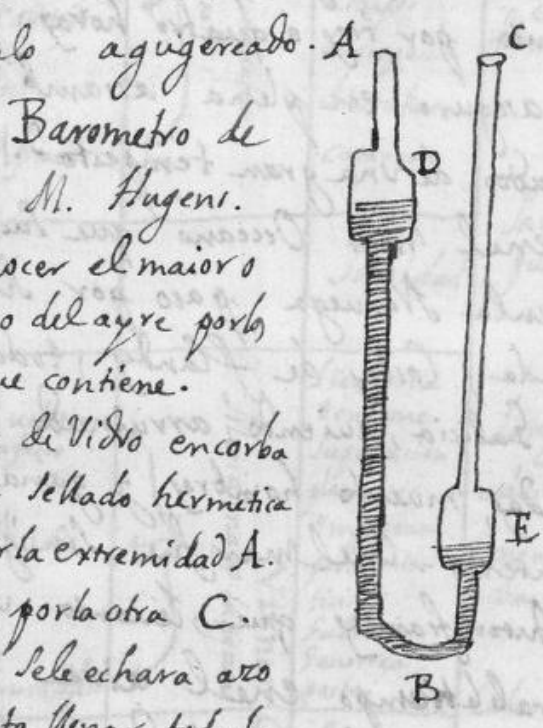
Fernández Navarrete's drawing of a Huygens barometer (FN 1703: 217r)
One noticeable feature of the monthly reports---the empirical output of the project---is how much they resemble medical case histories. The instrumental data and all kinds of meteorological phenomena---such as harmful winds, sudden frosts, or suffocating heat---form part of an anamnesis of the city and its inhabitants, in the same way as seasonal disease patterns, postmortem examinations, or the amount and color of sputum expectorated by the hospitalized. The epidemiological section of the Eph-M provide insights into the daily practice in Madrid's hospitals most of them quite characteristic of the early modern period.The medication, for instance, consisted mostly of purgatives, diuretics, and diaphoretics, i.e., remedies with the purpose of stimulating the excretion of superfluous and pathogenic matter, as taught by the Hippocratic humoral theory. The preferred therapy was, unsurprisingly, bloodletting (sangría), which was apparently administered almost regardless of the nature of a medical condition.
Fernández Navarrete rarely turns to astrological explications (certainly not as much as the rest of the "meteorological" texts published in Spain of that time):
Por las antecedentes tablas consta aver sido mucho menor el peso de la Atmosphera en este mes, que en el passado, por aver estado el ayre cargado de vapores, y nubes, que han regado la tierra, y contribuido no poco á la salud. Ha avido trece diferentes dias de lluvia, en especial estando la Luna en Aquario, y Piscis; assimismo vientos, granizo, y tempestad.Eph-M: 10
As shown in the preceding tables, the atmospheric pressure was this month significantly less than the month before because the air was saturated with vapor and clouds that have irrigated the soil and contributed considerably to public health. There have been 13 different rain days, particularly when the moon was standing in the signs of Aquarius and Pisces; likewise, there have been winds, hail, and thunderstorms
Although Fernández Navarrete put so much emphasis on the impact of weather on health, he made no specific connection between the instrumental measurements and particular diseases occurring at the same time. Apparently he had rather general effects in mind--perhaps we get a better understanding if we imagine the material world the Eph-M are referring to. The monthly accounts of the weather conditions provide visual descriptions of the impact on the city: rain sweeping through the streets of Madrid, in contrast, the same streets without having been rinsed through for weeks without precipitation, or the air pressing down without even a light breeze to ventilate the capital (probably what now is called an omega block preventing convection and causing smog-like effects). Now, let us picture the urban environment of early modern Madrid. The city had no sewer system by then (or any other European city, for that matter).A recent research project surveyed the sanitary history of Madrid, including the sanitary conditions in the 18th century and the first attempts to manage sewage and water supply (Pinto Crespo et al. 2015: 59-93). With some olfactory imagination, we may relate to the feeling of relief when the wind and rain dissipated the malodorous urban haze for a while.The "smellscape" of early modern Madrid was stoked by tanneries, limekilns, slaugtherhouses, and textile mills, all of which contributed to the local water pollution (Pinto Crespo et al. 2015: 23). A semantic fossil in today's Spanish reminds us of what was likely the signature odor of the early modern city: The expression ¡Aguas!, meaning "Watch out!", has its origin in the custom to politely warn in advance before pouring the contents of the chamber pot into the streets.
Regime Change
Then, with the September issue of the Eph-M, occurs something like a regime change. Instead of Fernández Navarrete, the title page displays a new name as author and person in charge: Alejandro Martinez Argandoña, anatomist and, like his predecessor, member of the academy and court physician.Eph-M, title page September, and Rodríguez de la Torre: «Martínez Argandoña, Alejandro» With the new director in command, changes were made immediately: New models of both thermometer and barometer are introduced (accompanied by scathing criticism of the devices used until thenMartinez Argandoña complains, for instance, about the complicated design and the "gravest flaws of the Florentine thermometer" («los gravissimos defectos del Thermometro Florentino», Eph-M: 55)), their pros and cons discussedEph-M: 54-58, the instruments are additionally tested for gauge discrepancies (Eph-M: 80f)., and the meteorological tables now provide the exact hours of the measurements which are performed six times a day.Eph-M: 44-53 (month of September, 1737), and Eph-M: 67-76 (month of October, 1737) Unlike the former director, Martinez Argandoña recognizes the challenges meteorological instruments entail, and he appears to be more familiar with the meteorological literature (this knowledge, though, is seemingly limited to French and Italian authors).Martínez Argandoña refers constantly to Réaumur (Eph-M: 54-80 passim) and makes mention of Philippe de La Hire (Eph-M: 57), Guillaume Amontons (55), Jacques Philippe Maraldi (80), Carlo Taglini (55), and Charpentier de Cossigny's instrumental observations on Madagascar and other places around the Indian Ocean (57). And---admittedly just a minor detail but possibly indicative of the internal dynamics of the academy---the dedication to Joseph Cervi, the academy's president, lists his titles and honorifics at length and is noticeably more deferential than in the previous issues.
El Docto Continuador de estas Ephemerides, como ya se ha manifestado en el titulo, es el Doctor Argandoña, quien ha puesto un particular estudio en descrivir estas Ephemerides con mayor claridad, methodo, y economia que en las antecedentes, porque el tiempo en qualquiera proyecto administra mas claras luzes con la reflexion, y exercicio, sin que este adelantamiento disminuya el distinguido merito de su erudito antecessor. [...] y amonestamos a los curiosos no dexen de verlas en sus originales, para celebrar la exactitud con que están hechas, y utilizarse en sus observaciones. Advertimos tambien, que el sabio continuador ha hecho sus observaciones, acerca del temple de ayre, por el Termometro de Mr. de Reaumur, por parecerle ser este mas exacto que el Florentino, cuyas razones, y experiencias son dignas de leerse en su original. No se debe omitir el lugar en que está colocado dicho Thermometro, que es en sitio cubierto, y cerca de dos ventanas, que mira la una al Mediodia, y la otra al Poniente, que recibe con alguna remision el temple del ayre."Diario de los literatos de España, 10-12/1737, No. 4: 361f
The learned successor to be in charge of the Ephemerides is, as indicated in the heading [of the article], Doctor Argandoña who has put particular effort into recording the Ephemerides with more clarity, method, and frugality than it was done in the previous editions, since, as in any project, the experience over the time offer new insights regarding the assessment and execution. However, these improvements do not diminish the distinguished the merits of the erudite predecessor. [...] We encourage anyone eager to learn more about that matter to consult the weather tables in the original publication [i.e., the Eph-M], to appreciate their exactness and to use them [as templates] for their own observations. Furthermore, we deem it to be noteworthy that the prudent successor has used Réaumur's thermometer for his observations on the temper of the air, as it seems to him to be more accurate than the Florentine, and his reasons and experiences are worthy of being read in the original. The place where the thermometer is located should not be omitted, which is in a covered place, and near two windows, one facing south and the other west, which receives the temper of the air with some remission.
What Martínez Argandoña presented as a new start turned out to be the final stage of the Madrilenian Ephemerides. The last fascicle of the Eph-M to appear in print was the October issue, although nothing indicated that this would be the end of the project. The last digest in the Diario, however, did cover the entire period from September to December with the instrumental records until the end of year 1737 (which suggests that the author of the anonymous digest is indeed the project's director or at least someone closely connected to the project).Diario 1737/4: 360-370. Just as there remain open questions regarding the funding of the project or the replacement of the director, there is also some uncertainty about the actual termination date of the project. There are indications that an attempt was made to resume the projectA short notice in the Diario that the Eph-M would be continued with a different printer (Diario 1738/5: 352). There is no evidence, however, that this undertaking came to fruition. and some sources suggest that while the Eph-M were discontinued, the instrumental observations did last for some time, perhaps years.Most researchers regard the discontinuation of the Eph-M as de facto closure of the observational activities. The likely reason was a lack of interest on part of the government (Anduaga Egaña 2012: 42; Rodrigo 2018: 2) or, more specifically, that the printing costs turned out to be too high in the long run (Mariscal y García de Rello 1936: 402). Hernández Morejón claims in his multivolume Historia bibliográfica de la medicina española (1843-1852) that the observations continued after yet another managerial turnover. The new person in charge, Jose Arcadio de Ortega [Hortega], proceeded "without interruption" until 1746 (Hernández Morejón VII, 1852: 77). A few recent research papers have repeated this assertion (e.g., López Terrada et al. 2020: 31).
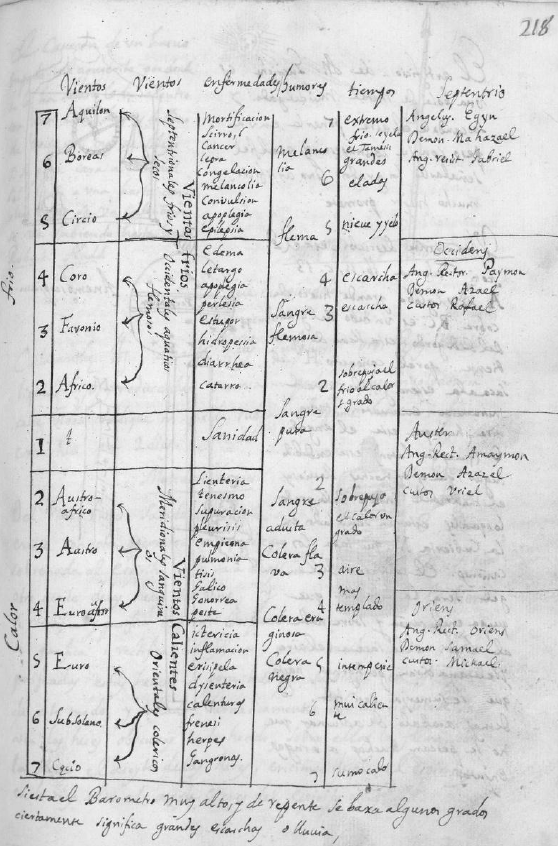
From Fernández Navarrete's manuscripts (1703: 218r): The page is part of several folios with excerpts from Robert Fludd and contemporaneous authors. The seven columns show particular wind and weather conditions (with spatial and temporal connotations), correspondent diseases, and the domains of benevolent/malicious entities: (1) Fludd's cosmological number scheme, (2) Wind names, (3) Wind qualities (cold, arid etc.), (4) Diseases, (5) Humors, (6) Weather conditions, (7) [Unnamed] Column 7: Demons, Archangels, Spirits. While the source is likely Fludd, there were a few other medical authors xxx grimoires; Fludd: condemned by the Inquisition for several of his works (Martinez de Bujanda 2016: 563)
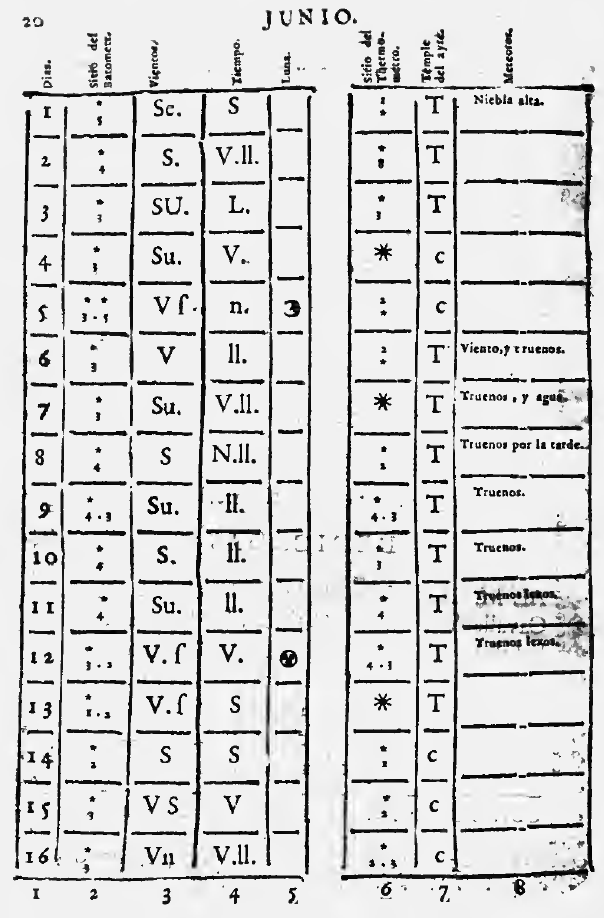
Eph-M: 20
An example for the table design of the Ephemerides during Fernández Navarrete's tenure: Moon phases, Meteoros, daily measurements
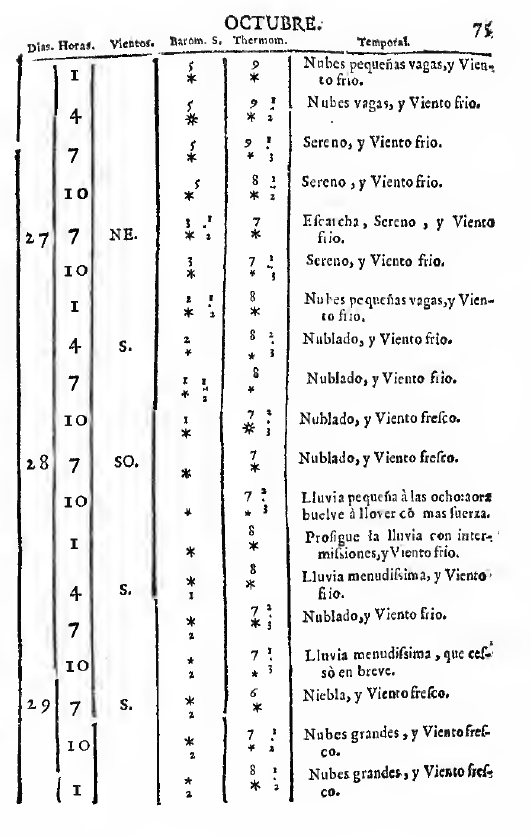
Eph-M: 75
Ephemerides, October 27-29: Measurements are now performed four times a day, the column for the moon has been dropped.
The Aftermath
The Ephemerides Matritenses did not attract much attention beyond Spain, except for the English physician Thomas Stack who translated a selection of the Eph-M for the Royal Society.Stack 1738a and 1738b; see also Jones Corredera 2019: 963 Stack's Paper, 'Introduction to the Ephemerides of the Royal Academy of Madrid containing some account of the Institution of that Academy' by Francis Fernandez Navarette[sic!] is largely an English summary of Fernández Navarrete's introduction to the first issue of the Ephemerides matritenses, his translation underscores, however, the break with Spain's longtime academic traditions: "They desire that Scholastic Disputes may be forgot, which have been so great an impediment to the Advancement of Learning [..]."Stack 1738b (CLP/22ii/79): 2v Meanwhile in Spain, Andrés PiquerLike Fernández Navarrete, he was a member of the Academia Médico-Matritense and the Protomedicato (the board in charge of licensing physicians, surgeons, and pharmacists); for his biography and institutional affiliatons see Balaguer Perigüell, and, in minute detail, De Paredes Cencillo 2020: 35-110 continued the tradition of medical meteorology, though not without reservation. On the one hand he refers repeatedly to the meteorological instruments, e.g., to state that the thermometer is more reliable than the human temperature sensationPiquer 1747: 74; context matters, though: the quote is from a chapter on the Pyrrhonist school of scepticism, i.e., his point is less the precision of instruments but the fallability of human perception., or to remark that there is barely any curious person who would not have a barometer in their home to learn about the movements of the air (he means, of course, anyone in the learned class)."Estos hechos son incontrastables, apenas ay curioso que no tenga en su casa el barómetro para conocer las mudanzas del aire." (Piquer 1745: 366); see also his considerations on the barometer's precision (Piquer 1745: 365-373).
Las observaciones utiles, assi en la Physica Experimental, como en la Medicina, son las primeras, que hemos llamado generales: las otras, que llamamos particulares, son de poca utilidad. Por esta razon en la Physica las observaciones que se hacen con redomas, instrumentos, y máquinas son de poquissimo uso, porque aquella operacion, que se descubre con la máquina, ó el instrumento, solo muestra el modo de obrar la naturaleza con la aplicacion de essas cosas, de modo, que lo que entonces se ve, y se observa, no se cumple en las operaciones, en que tales instrumentos no intervienen. Por esso quisiera yo, que la juventud se aplicasse, assi en las cosas de la Physica, como de la Medicina, a las observaciones generales y perpetuas, mas que a las particulares. [..] Bolbiendo ahora a nuestro Hippocrates, conviene saber, que fue el mas exacto y diligente observador de la antiguedad, y sus observaciones son generales, perpetuas, y uniformes; y por esso, bien entendidas, siempre se verifican.Hipócrates 1757: LVI/LVII
Genuine useful observations, be it in experimental physics or in medicine, are primary perceptions which we have named the general ones: the other kind of observation which we call the particular ones, do not offer much utility. This is the reason why observations made with the help of phials, instruments, and machines are indeed of very little use because discoveries made with machines and instruments only show nature under the application of these things but what can be seen or observed by this means cannot be verified by inquiries without the involvement of those instruments. Therefore, I want the youth to resort in matters of both physics and medicine to general and perpetual observations, rather than to the particular ones. [...] Returning now to our Hippocrates, it is worth knowing that he was the most exact and diligent observer in the ancient world, and his observations are general, perpetual, and uniform; because of this, they always turn out to be correct.
In order to translate these lines into philosophical terms: Piquer frames the difference between the study of ancient authors like Hippocrates and the use of modern instruments as the opposition of deductive vs inductive inquiries---which equates in the philosophical rivalry of the time the antithetical forces of Scholasticism vs Empiricism, and he sides with the former.
After the short-lived Madrid project, it took decades to start new endeavours in the same veinAitor Anduaga Egaña has pointed out that Spanish meteorologist in the late 18th and early 19th century continuously deplored the delay and backwardness of their discipline compared to other European countries (Anduaga Egaña 2012: 44-47). Fernández Navarrete, as seen above, had already voiced the same criticism in the introduction to the Eph-M.: BarcelonaAccording to Aitor Anduaga Egaña, the physician Francisco Salva Campillo followed with his meteorological observations in Barcelona the model of the Ephemerides Matritenses (Anduaga Egaña 2012: 43) and MadridVaquero et al 2022: 208 in the 1780sIn this years two publications discussed instrumental meteorology in domains other than medicine: Memoria sobre la construcción y uso de los Instrumentos Meteorológicos by Vicente Alcalá Galiano (1783) and La Meteorología aplicada a la Agricultura by Giuseppe Toaldo [transl.] and Vicente Alcalá Galiano (1786); see the reprint of both works in García Hourcade 2002., and, with the institutional support of the Spanish navy, the cadet school in San Fernando (Cádiz)Anduaga Egaña 2012: 31-35; Domínguez-Castro et al. 2014: 594; Vaquero et al 2022: 208; The library of the Real Observatorio de la Armada holds archival records pertinent to this period: https://armada.defensa.gob.es/ArmadaPortal/page/Portal/ArmadaEspannola/cienciaobservatorio/prefLang-es/08Biblioteca. An initiative of the Ministry of Marine to establish a network of meteorological observatories did not come to fruition because of the Napoleonic WarsDomínguez-Castro et al. 2014: 594.
In 1852, the physician and military surgeon Vicente Martínez y Montes published a book that reads like a farewell to the medical meteorology as practiced by Fernández Navarrete and other early modern physicians who had adopted the novel meteorological instruments for their medical practice. Martínez y Montes makes a clear distinction ---- or rather, he draws an epistemological line ---- between medicine and meteorology which he acknowledges to be a "new science" ("la meteorologia, esa ciencia nueva"Martínez y Montes 1852: 129) and a discipline in its own right. Because of their intrinsic differences, meteorology studies weather conditions as such, whereas medicine examines how weather and climate affect the human body, both disciplines have different aims and methods:
[...] al estudiar su temperatura, no podemos contentarnos con datos aislados, con su media termométrica, barométrica etc. sino que es preciso reunir todos los demas elementos del higrómetro, pluviómetro, anemómetro, para tener un todo algo homogéneo, del que se pueda desprender la mayor verdad posible.Martínez y Montes 1852: 129f
When we [physicians] are studying the temperature, we cannot content ourselves with isolated data, with thermometric and barometric averages, etc.; instead, we have to consolidate all the data measured with the hygrometer, the pluviometer, the anemometer, into a somewhat homogenous entirety, so that we can get as close to the truth as possible.
If physicians would look only at the temperature records as produced by meteorologists, Martínez y Montes argues, they would miss what is more significant than the daily means, e.g., rapid temperature spikes and any kind of sudden change that stresses the human body.Martínez y Montes 1852: 130 By decoupling the medical approach to the weather from meteorology, the human body appears to be reinstated as instance of measure: When instrumental measurements are contradictory to human perceptions, a physician should not simply dismiss the latter as a meteorologist would do.Martínez y Montes 1852: 130 Furthermore, the two disciplines operate in different spaces. Meteorologists who seek to exclude human interference, keep their distance from inhabited areas, whereas physicians need to conduct their studies and set up their measuring devices where people live:
Convienen al metereologista, para su estudio, las regiones á cubierto de la accion del suelo, lejos de las habitaciones, y que estén bien aisladas, puesto que todos sus medios de investigación tienden á asegurarle observaciones prontas y precisas, enteramente independientes de las mudanzas accidentales, debidas á las localidades [...]: el médico, por la inversa, hace sus observaciones metereológicas en las capas inferiores del aire, prócsimo á la tierra, á los sitios habitados, al centro de las poblaciones, llevando por objeto [...] el conocimiento de todas las causas apreciables modificadoras de la sensibilidad.Martínez y Montes 1852: 132
The meteorologist considers those areas suitable for his studies that are protected from the action on the ground, far from the settlements and quite isolated because all his means of research aim to ensure precise and fast observations, entirely independent of random variations of local origin [...]. The physician on the other hand, conduces his meteorological studies in the lower layer of the air, close to the ground and the settlements, amidst the population, and with the aim to learn all the main reasons for [weather] sensitivity.
Martínez y Montes is not the only medical author with this position on the issue.Martínez y Montes draws, in fact, heavily on a book by the French physician Joseph-Jean-Nicolas Fuster, who had made the argument that physicians who examine the impact of weather and climate on the living body, pursue different research objectives than meteorologists, and they should therefore apply different methods and produce observational records of their own (Fuster 1840: 631).
In hindsight, this arguably marks the retreat of medicine from the field of weather studies, which had become the almost exclusive turf of meteorology, now a discipline in its own right.Interestingly, Martínez y Montes' argumentation has notable parallels with the line of reasoning in Fleming/Jankovic's criticism of modern meteorology: "This layer [i.e., the "layer of air within two meters of the ground" or "anthropocentric layer"] has not been fully or even adequately explored, which is unusual, since it is so accessible to us—as intimately close as our next breath. Indeed, it has been consciously excluded from environmental analysis. In the second half of the nineteenth century meteorologists adopted a policy of locating their instruments in shelters two meters above the ground. In an attempt to standardize their measurements and compare measurements over widespread areas, they began to consider the layer of air adjacent to the ground “a zone of disturbance” to be excluded from scientific analysis." (Fleming/Jankovic 2011: 4) The central questions posed in the Ephemerides Barometrico-Medicas Matritenses are still raised today, though. Fernández Navarrete's central tenet was the inextricable link between a particular place and the health of its population, and he was specifically concerned about air, water, and soil, all of which are still, probably even more than ever, a cause of health concerns. What has fundamentally changed is how we understand and perceive the world around us. It is not a malicious wind from the north that brings disease upon us but airborne particles generated from fossil fuels. On an epistemological level, there are, of course, fundamental differences between the early modern idea of the "natural history" influencing the local population and today's awareness of environmental pollution linked to disease and premature deaths. Viewed from experience of an environment fraught with risk, the medical meteorology of yore did not lose its relevance.

Portada 1737
The full title, Ephemerides barometrico-medicas matritenses, para el mas puntual, y exacto calculo de las observaciones que han de ilustrar la Historia Natural, y Medica de España, sums up the central subject and goal of the project: Producing daily "barometric" (i.e., meteorological) and medical records of the city of Madrid, in order to create precise and exact data for a (future) study of the natural and medical history of Spain. The dedicatory address at the bottom continues on the following pages and---aside from plenty courtesy and decorum directed to Giuseppe Cervi, the academy's president for life and "primer Medico del Rey y Reyna"---briefly explains the purpose of the newly founded Academy of Medicine as an institution for the benefit of public health.
References:
Academia Médica Matritense. n.d. Estatutos de La Academia Medica Matritense, Aprobados Por El Real y Supremo Consejo de Castilla. Madrid: Academia Médica Matritense. http://bibliotecavirtual.ranf.com/es/consulta/registro.do?id=10128.
Acosta, José. 2008. Historia Natural y Moral de Las Indias. Edited by Fermín Pino-Díaz and Fermín Pino Díaz. Madrid: Consejo Superior de Investigaciones Científicas.
Alberola Romá, Armando. 2015. “Tiempo, Clima y Enfermedad En La Prensa Española de La Segunda Mitad Del Siglo XVIII. Diarios Meteorológicos y Crónicas de Desastres En El Memorial Literario.” El Argonauta Español 12. https://doi.org/10.4000/argonauta.2142.
Alemán, Mateo, and German Bleiberg. 1977. “El «Informe Secreto» de Mateo Alemán Sobre El Trabajo Forzoso En Las Minas de Almadén.” Estudios de Historia Social: Revista Del Instituto de Estudios de Sanidad y Seguridad Social, no. 2–3: 357–443. https://archive.org/details/MATEO_ALEMAN_INFORME_SECRETO.
Alencé, Joachim d’. 1688. Abhandlung Dreyer so Nothwendig-Als Nützlichen Instrumenten, Nemlich Deß Barometri, Thermometri Und Notiometri Oder Hygrometri. Der Lufft Geringste Veränderungen in Schwere Und Leichte, in Wärme Und Kälte, in Feuchte Und Truckne, Auff Das Genaueste Zu Beobachten. Translated by Johann Crato Hiegel. Mainz: Ludwig Bourgeat. https://onb.digital/result/10935F8E.
Anduaga Egaña, Aitor. 2012. Meteorología, Ideología y Sociedad En La España Contemporánea. Madrid: CSIC, Consejo Superior de Investigaciones Científicas.
Anonymous. 1737a. “Articulo IV. Ephemerides Barometrico-Medicas Matritenses, Junio, Julio, Agosto.” Diario de Los Literatos de España 1: 134–64. http://hemerotecadigital.bne.es/issn/2484-9790.
———. 1737b. “Articulo XVIII. Ephemerides Barometrico-Medicas Matritenses, de Los Meses de Septiembre, Octubre, Noviembre, y Diciembre Del Año 1737, Extractadas de Orden de La Real Academia Medica, Por El Doctor Don Alexandro Martinez.” Diario de Los Literatos de España 1: 360–70. http://hemerotecadigital.bne.es/issn/2484-9790.
———. 1737c. “Articulo XXII. Ephemerides Barometrico-Medicas Matritenses Para El Mas Puntual, y Exacto Calculo de Las Observaciones Que Han de Ilustrar La Historia Natural, y Medica de España: Extractadas de Orden de La Real Academia Medico-Matritense, Por El Doct. D. Francisco Fernandez Navarrete [...].” Diario de Los Literatos de España 1: 311–40. http://hemerotecadigital.bne.es/issn/2484-9790.
Aristotle. 1952. Meteorologica. Greek/English. Translated by H. D. P. Lee. Loeb Classical Library 397. Cambridge, MA: Harvard University Press. https://www.loebclassics.com/view/LCL397/1952/volume.xml.
Balaguer Perigüell, Emilio. 1982. “Continuidad y Ruptura En La Renovación Científica Valenciana.” Revista de Historia Moderna, no. 2: 251–58. https://doi.org/10.14198/RHM1982.2.09.
———. n.d. “«Piquer y Arrufat, Andrés», En Real Academia de La Historia, Diccionario Biográfico Electrónico.” https://historia-hispanica.rah.es/biografias/36352-andres-piquer-y-arrufat.
Ballester Añón, Rosa. n.d. “«Cervi, Giuseppe», En Real Academia de La Historia, Diccionario Biográfico Electrónico.” https://historia-hispanica.rah.es/biografias/11638-giuseppe-cervi.
Bel Bravo, María Antonia, and Juan Obra Sierra. 1986. “Documentos Para El Estudio de La Inquisición En Granada.” Chronica Nova. Revista de Historia Moderna de La Universidad de Granada 15 (315-328). http://hdl.handle.net/10481/26014.
Benedek, Thomas G. 2015. Rheumatism: Its History from Paleo-Pathology to the Advent of Experimental Science. New York: Nova Biomedical.
Betancourt, Agustín de. 1783. “Memorias de Las Reales Minas de Almadén, 1783, i-III.” Manuscript. Madrid: Biblioteca Nacional de España (MSS/10427-10429). http://bdh-rd.bne.es/viewer.vm?id=0000042440.
Bustamante Oleart, Carlos. 2020. “La Historia Del Viento En Las Ciudades = the History of the Wind in the Cities.” Cuadernos de Investigación Urbanística, no. 132: 1. https://doi.org/10.20868/ciur.2020.132.4510.
Camuffo, Dario, and Chiara Bertolin. 2011. “The Earliest Temperature Observations in the World: The Medici Network (1654–1670).” Climatic Change 111 (2): 335–63. https://doi.org/10.1007/s10584-011-0142-5.
Carreras Panchón, Antonio. n.d. “«Hernández Morejón, Antonio.», En Real Academia de La Historia, Diccionario Biográfico Electrónico.” https://historia-hispanica.rah.es/biografias/21458-antonio-hernandez-morejon.
Chinchilla, Anastasio. 1841. Anales Históricos de La Medicina En General, y Biográfico-Bibliográficos de La Española En Particular. Vol. 5. Valencia: Lopez y Compañia. https://archive.org/details/b2933858x_0005/.
Colón, Cristóbal. 2003. Textos y Documentos Completos. Edited by Consuelo Varela and Juan Gil. 3. reimpr. de la 2. ed. Madrid: Alianza Editorial.
Comisión Nacional del Agua (CONAGUA. 2012. Servicio MeteorológicoNacional:135 Años de Historia En México. México, D.F.: Secretaría de Medio Ambiente y Recursos Naturales. https://www.gob.mx/conagua.
De Paredes Cencillo, Carlos. 2020. “Andrés Piquer y Arrufat (1711-1772). Un Médico Ilustrado Entre La Universidad de Valencia y La Corte.” PhD thesis, Valencia: Universitat de València.
Díez de Revenga Torres, Pilar. 2010. “Una Actividad Poco Conocida de Mateo Alemán: La Visita a Las Minas de Almadén.” In De Moneda Nunca Usada. Estudios Filológicos Dedicados a José Ma. Enguita Utrilla, edited by Rosa María Castañer Martín and Vicente Lagüéns Gracia, 219–25. Zaragoza: Instituto Fernando el Católico. https://ifc.dpz.es/recursos/publicaciones/29/95/_ebook.pdf.
Domínguez-Castro, F., R. M. Trigo, and J. M. Vaquero. 2013. “The First Meteorological Measurements in the Iberian Peninsula: Evaluating the Storm of November 1724.” Climatic Change 118 (2): 443–55.
Domínguez‐Castro, F., J. M. Vaquero, F. S. Rodrigo, A. M. M. Farrona, M. C. Gallego, R. García‐Herrera, M. Barriendos, and A. Sanchez‐Lorenzo. 2014. “Early Spanish Meteorological Records (1780–1850).” International Journal of Climatology 34 (3): 593–603. https://doi.org/10.1002/joc.3709.
Durán López, Fernando. 2021. “De Las Seriedades de Urania a Las Zumbas de Talía. Astrología Frente a Entretenimiento En La Censura de Los Almanaques de La Primera Mitad Del XVIII.” Cuadernos de Estudios Del Siglo XVIII, no. 6: 1–202. https://doi.org/10.17811/cesxviii.6.2021.1-202.
Feijoo, Benito Jerónimo OSB. 1769. Teatro Critico Universal, ó Discursos Varios En Todo Género de Materias, Para Desengaño de Errores Comunes. Vol. II. Madrid: Joaquín Ibarra. https://bibliotecadigital.museodelprado.es/pradobib/es/bib/10315.do.
Fernández Navarrete, Francisco. 1719. El Nereo Director, y Juez Medicinal, Entre Las Verdaderas, y Supuestas Virtudes, y Vso Legitimo Del Agua Pura, Elemental, Natural, En Sanos, y Enfermos, Como Bebida, y Como Medicina. Granada: Imprenta de Nicolàs Prieto. https://digibug.ugr.es/flexpaper/handle/10481/8759/a-038-308%20(1).pdf.
———. 1738. “Articulo VIII. Carta Del Doctor Don Francisco Fernandez Navarrete, Medico de Camara de s.m. A Los Autores Del Diario.” Diario de Los Literatos de España 2: 167–81. http://hemerotecadigital.bne.es/issn/2484-9790.
———. 1745. “Tomo 2médico de Miscelánea Médica.” Real Academia Nacional de Medicina, Sign. M-10-07-M-02. Manuscript. http://bibliotecavirtual.ranm.es/ranm/es/consulta/registro.do?id=1241.
Fernández Navarrete, Francisco. 1997. Cielo y Suelo Granadino. Edited by Antonio Gil Albarracín. Almeria: Griselda Bonet Girabet.
Fludd, Robert. 1631. Integrvm Morborvm Mysterivm: Sive Medicinae Catholicae Tomi Primi Tractatvs Secundus, in Sectiones Distributus Duas; Quorvm Prior Generalem Morborum Naturam [...] Describit. 1,2 vols. Frankfurt: Fitzer. https://mdz-nbn-resolving.de/details:bsb11394884.
Foucault, Michel. 2011. The Courage of Truth. Edited by Mr Graham Burchell and Arnold I. Davidson. Michel Foucault, Lectures at the Collège de France. Basingstoke: Palgrave Macmillan.
Fuster, Joseph-Jean-Nicolas. 1840. Des Maladies de La France Dans Leurs Rapports Avec Les Saisons, Ou Histoire Médicale Et Météorologique de La France. Paris: Dufart.
García de Cortázar Nebreda, Margarita. 2023. “La Construcción de La Física Moderna En La Sociedad Española Del Siglo XVIII: Obras, Autores y Públicos.” PhD thesis, Valencia: Universitat de València.
García Gómez, Montserrat, José Diego Caballero Klink, Paolo Boffetta, Santiago Español, Gerd Sällsten, and Javier Gómez Quintana. 2007. “Exposure to Mercury in the Mine of Almadén.” Occupational and Environmental Medicine 64 (6): 389–95. https://doi.org/10.1136/oem.2006.030940.
García Hourcade, Juan Luis. 2002. La Meteorologı́a En La España Ilustrada y La Obra de Vicente Alcalá Galiano. Edited by Asociación cultural Biblioteca de Ciencia y Artillerı́a. (Biblioteca de Ciencia y Artillerı́a). Segovia : Asociación cultural Biblioteca de Ciencia y Artillerı́a. http://bibliotecavirtual.ranm.es/ranm/es/consulta/registro.do?id=74707.
García-Pulido, Luis José. 2016. “La Representación Gráfica Del Territorio Granadino En Los Mapas Topográficos Del Siglo XIX.” EGA. Revista de Expresión Gráfica Arquitectónica 21 (27): 242. https://doi.org/10.4995/ega.2016.4744.
Gil Albarracín, Antonio. 2018. “«Francisco Fernández Navarrete», En Real Academia de La Historia, Diccionario Biográfico Electrónico.” https://dbe.rah.es/biografias/23422/francisco-fernandez-navarrete.
———. n.d. “«Fernández Navarrete, Francisco», En Real Academia de La Historia, Diccionario Biográfico Electrónico.” https://historia-hispanica.rah.es/biografias/16733-francisco-fernandez-navarrete.
Gil Bautista, Rafael. 2009. “Medicina y Minería En El Almadén Del Siglo XVIII: Joseph Parés y Franqués (Mataró, 1720-Almadén, 1798).” Revista de Historia Moderna, no. 27: 333–61. https://doi.org/10.14198/rhm2009.27.14.
Ginzburg, Carlo. 1992. Clues, Myths, and the Historical Method. Translated by Anne Tedeschi and John Tedeschi. Baltimore: Johns Hopkins Univ. Press.
———. 2012. Threads and Traces: True, False, Fictive. Translated by Anne Tedeschi and John Tedeschi. Berkeley: University of California Press.
Gómez de Enterría, Josefa. 2015. “El Vocabulario de La Medicina En El Español Del Siglo XVIII.” In Actas Del IX Congreso Internacional de Historia de La Lengua: Cádiz, 2012, edited by García Martín José and Teresa Bastardín Candón, 361–92. Frankfurt a. M., Madrid: Vervuert Verlagsgesellschaft. https://doi.org/10.31819/9783964566492-017.
Gómez Ortiz, A., B. Milheiro Santos, and D. Serrano Giné. 2013. “Nieves, Hielos y Aguas En Los Paisajes de Sierra Nevada : El Interés de La Información Gráfica de Los Libros de Época.” Cuadernos de Investigación Geográfica 34: 101–18. https://doi.org/10.18172/cig.1209.
González Bueno, Antonio. n.d. “«Hortega y Hernández, José», En Real Academia de La Historia, Diccionario Biográfico Electrónico.” https://historia-hispanica.rah.es/biografias/22791-jose-hortega-y-hernandez.
González de Posada, Francisco. 2019. “Contextualized History of the Real Academia Médica Matritense.” ANALES RANM 136 (02): 179–88. https://doi.org/10.32440/ar.2019.136.02.rev12.
Guariento, Luca. 2018. “From the Divine Monochord to the Weather-Glass: Changing Perspectives in Robert Fludd’s Philosophy.” In Evidence in the Age of the New Sciences, 151–76. Springer. https://doi.org/10.1007/978-3-319-91869-3_7.
Guijarro Mora, Víctor. 2005. “El Barómetro y Los Proyectos Meteorológicos de La Ilustración: El Caso Español.” ENDOXA, no. 19: 159–90. https://doi.org/10.5944/endoxa.19.2005.5109.
Hernández Morejón, Antonio. 1850. Historia Bibliográfica de La Medicina Española, Tomo VI. Madrid: Viuda de Jordán e Hijos.
———. 1852. Historia Bibliográfica de La Medicina Española, Tomo VII. Madrid: Viuda de Jordán e Hijos.
Hipócrates. 1757. Las Obras de Hippocrates Más Selectas, Tomo Primero. Edited and translated by Andrés Piquer. Madrid: Joachin Ibarra. https://bvpb.mcu.es/es/consulta/registro.do?id=577201.
Jones Corredera, Edward. 2019. “The Rediscovery of the Spanish Republic of Letters.” History of European Ideas 45 (7): 953–71. https://doi.org/10.1080/01916599.2019.1632730.
Jovellanos, Gaspar Melchor de. 2024. “Obras Completas de Jovellanos (Versión Digital de La Edición Crítica 1928-1995).” Museo Casa Natal de Jovellanos; Instituto Feijoo de Estudios del Siglo XVIII. 2024. https://www.unioviedo.es/jovellanos/.
Jurin, James (Jacobus). 1723. “Invitatio Ad Observationes Meteorologicas Communi Consilio Instituendas.” Philosophical Transactions of the Royal Society of London 32 (379): 422–27. https://doi.org/10.1098/rstl.1722.0082.
León Sanz, Pilar, and Dolores Barettino Coloma. 2007. Vicente Ferrer Gorraiz Beaumont y Montesa| (1718 - 1792), Un Polemista Navarro de La Ilustracion. Temas de Historia de La Medicina 6. Pamplona: Gobierno de Navarra, Departemento de Salud.
Lera García, Rafael. 1988. “Venta de Oficios En La Inquisición de Granada (1629-1644).” Hispania: Revista Española de Historia 48 (170): 909–62.
Lera García, Rafael de. 1989. “Gran Ofensiva Antijudía de La Inquisición de Granada 1715-27.” Chronica Nova. Revista de Historia Moderna de La Universidad de Granada 17 (147-170). https://revistaseug.ugr.es/index.php/cnova/article/view/2831.
Llorente, Juan Antonio. 1836. Historia Crítica de La Inquisición de España; Obra Original Conforme á Lo Que Resulta de Los Archivos Del Consejo de La Suprema,y de Los Tribunales de Provincia. Tomo VIII. Barcelona: Oliva. https://archive.org/details/bub_gb_2ZsuAAAAYAAJ/.
López Andújar, G., and J. L. Valverde. 1986. “El Manuscrito de La ‘Historia Natural’ Del Dr. Francisco Fernández Navarrete (s: XVIII).” Ars Pharmaceutica 27 (3): 263–69. https://revistaseug.ugr.es/index.php/ars/article/view/25518.
López, Pedro J. Tárraga, Juan Solera Albero, and Enrique Arjona Laborda. 2020. “De Las Reales Academias de Medicina Del Siglo XVIII a La Academia de Medicina de Castilla La Mancha Del Siglo XXI.” Journal of Negative and No Positive Results 5: 141–55. https://doi.org/10.19230/jonnpr.3512.
López Terrada, María Luz, José Luis Fresquet Febrer, and Carla Pilar Aguirre Marco. 2008. Hernández Morejón, Anastasio Chinchilla y La Historia de La Medicina Española. Vol. LVII. Cuadernos Valencianos de Historia de La Medicina y de La Ciencia. Valencia: Instituto de Historia de la Medicina y de la Ciencia, Universitat de València. http://hdl.handle.net/10261/83439.
Mariscal y García de Rello, Nicasio. 1036. “Historia General de La Academia Nacional de Medicina. Discurso de Nicasio Mariscal y García, [Leído] El Sábado 15 de Diciembre de 1934.” In Academia Nacional de Medicina 1734-1934: Publicaciones Conmemorativas de II Centenario de Su Fundación. Conferencias, 377–444. Madrid: J. Cosano. http://bibliotecavirtual.ranm.es/ranm/es/consulta/registro.do?id=100871.
Martinez de Bujanda, Jesús. 2016. El Índice de Libros Prohibidos y Expurgados de La Inquisición Española (1551-1819). Madrid: Biblioteca de Autores Cristianos.
———. 2019. Censura de La Inquisición y de La Iglesia En España (1520-1966). Madrid: Biblioteca de Autores Cristianos.
Martínez Martínez, Manuel. 2007. “Los Forzados de Marina. El Caso de Los Gitanos (1700-1765).” Tesis doctoral, Almería: Universidad de Almería. https://dialnet.unirioja.es/servlet/tesis?codigo=218806.
Martínez y Montes, Vicente. 1852. Topografía Médica de La Ciudad de Málaga. Málaga: Círculo Literario.
McConnell, Anita. 2005. “Origins of the Marine Barometer.” Annals of Science 62 (1): 83–101. https://doi.org/10.1080/0003379031000095767.
Medina, Pedro de. 1545. Arte de Nauegar En Que Se Contienen Todas Las Reglas, Declaraciones, Secretos y Auisos q[ue] a La Buena Nauegacio[n] Son Necessarios, y Se Deue[n] Saber. Valladolid: Francisco Fernández de Córdoba. http://bdh-rd.bne.es/viewer.vm?id=0000050728.
Menéndez Navarro, Alfredo. 1991. “Un Testimonio Médico Sobre Las Condiciones de Vida de Trabajo de Los Mineros de Almadén En La Segunda Mitad Del Siglo XVIII.” Acta Hispanica Ad Medicinae Scientiarumque Historiam Illustrandam 11: 147–96. https://dialnet.unirioja.es/servlet/articulo?codigo=1311812.
Minniti, Francesco. 1690. Armonia Astro-Medico-Anatomica, o Sia Colleganza Degl’astri Con Il Microcosmo, e Di Questo Con i Vegetabili : Con Un’appendice Della Nautica [...]. Venice: Giovanni Francesco Valvasense.
Monter, Edward William. 2002. Frontiers of Heresy: The Spanish Inquisition from the Basque Lands to Sicily. Cambridge Studies in Early Modern History. Cambridge, [U.K.]: Cambridge University Press.
Morales Segura, Cristina. 2019. Galeotes de Mercurio. El Caso de Mateo Alemán: La Interacción Entre El Derecho y La Literatura En El Informe de La Mina de Mercurio de Almadén y El Guzmán de Alfarache. Historia Del Derecho. Madrid: Universidad Carlos III de Madrid.
Nomdedeu Rull, Antoni, and Sandra Iglesia Martín. 2013. “Diccionario Histórico Del Español Moderno de Aparatos de Física Experimental: Documentación de Los Términos Del Siglo XVIII.” Asclepio 65 (2). https://doi.org/10.3989/asclepio.2013.20.
Noreña, Carlos. 1970. Juan Luis Vives. International Archives of the History of Ideas v.34. The Hague: Martinus Nijhoff.
Olcina Cantos, Jorge. 2014. “Enseñanzas Climáticas En La Obra de Kant.” Anales de Geografía de La Universidad Complutense 34 (2). https://doi.org/10.5209/rev_aguc.2014.v34.n2.47075.
Palanco, Francisco (O. Minim.). 1714. Dialogus Physico-Theologicus Contra Philosophiae Novatores Sive Thomista Contra Atomistas. Madrid: ex typis Blasij de Villa-Nueva. https://babel.hathitrust.org/cgi/pt?id=ucm.5325859421.
Panizo Santos, Ignacio. 2018. “Fuentes Para El Estudio de La Última Etapa de La Inquisición Española.” Ayer. Revista de Historia Contemporánea 109 (1): 199–234. https://doi.org/10.55509/ayer/109-2018-08.
Pérez, Nuria Valverde. 2007. Actos de Precisión: Instrumentos Científicos, Opinión Pública y Economía Moral En La Ilustración Española. Estudios Sobre La Ciencia 47. Madrid: Consejo Superior de Investigaciones Científicas.
Phillips, Laura. 2021. “Medical Astrology: Science, Art, and Influence in Early-Modern Europe, Online Exhibition.” https://onlineexhibits.library.yale.edu/s/medicalastrology; Harvey Cushing/John Hay Whitney Medical Library; Medical Historical Library at Yale University.
Pinto Crespo, Virgilio, Rafael Gili Ruiz, and Fernando Velasco Medina. 2015. “Historia Del Saneamiento de Madrid. Proyecto de Investigación.” https://www.madrid.org/bvirtual/BVCM019290.pdf; Centro de Documentación para la Historia de Madrid, Universidad Autónoma de Madrid.
Piquer, Andrés. 1745. Fisica Moderna Racional, y Experimental. Valencia: Pasqual Garcia. https://wellcomecollection.org/works/sbkkwtnx.
———. 1747. Logica Moderna, o Arte de Hallar La Verdad y Perficionar La Razon. Valencia: Joseph García. http://bdh.bne.es/bnesearch/detalle/bdh0000083234.
Real Academia Medico-Matritense. 1737. Ephemerides Barométrico-Médicas Matritenses. Madrid: Imprenta Real. https://bvpb.mcu.es/es/consulta/registro.do?id=452762.
Real Academia Nacional de Medicina de España (RANME), ed. 2025. X Aniversario de La Proclamación de s. M. El Rey Felipe VI. Aportación de Las Reales Academias de Medicina de España. Madrid: RANME. https://ranm.es/wp-content/content/publicaciones/aportaciones-rraa/Aportacion-de-las-Reales-Academias-de-Medicina-de-Espana/.
Reyes Gómez, Fermín. 2000. El Libro En España y América: Legislación y Censura (Siglos XV - XVIII). 1–2 vols. Madrid: Arco/Libros.
Robertson, Kellie. 2019. “Scaling Nature: Scaling Nature: Microcosm and Macrocosm in Later Medieval Thought.” Edited by Sarah Kay and Nicolette Zeeman. Journal of Medieval and Early Modern Studies 49 (3): 609–31. https://doi.org/10.1215/10829636-7724697.
Rodrigo Sánchez, Fernando. 2016. “Afecciones Metereológicas: Medicina y Meteorología En Andalucía, 1754-1852.” OHM: Obradoiro de Historia Moderna, no. 25. https://doi.org/10.15304/ohm.25.2944.
———. 2019. “The Climate of Granada (Southern Spain) During the First Third of the 18th Century (1706–1730) According to Documentary Sources.” Climate of the Past 15 (2): 647–59. https://doi.org/10.5194/cp-15-647-2019.
———. 2020. “Recovering Climate Data from Documentary Sources: A Study on the Climate in the South of Spain from 1792 to 1808.” Atmosphere 11 (3): 296. https://doi.org/10.3390/atmos11030296.
Rodríguez de la Torre, Fernando. n.d.a. “«Martínez Argandoña, Alejandro», En Real Academia de La Historia, Diccionario Biográfico Electrónico.” https://historia-hispanica.rah.es/biografias/27939-alejandro-martinez-argandona.
———. n.d.b. “«Monleón y Ramiro, Tomás Francisco.», En Real Academia de La Historia, Diccionario Biográfico Electrónico.” https://historia-hispanica.rah.es/biografias/31105-tomas-francisco-monleon-y-ramiro.
Ruiz Veintemilla, Jesús M. 1977. “El «Diario de Los Literatos de España» y Sus Modelos.” Cuadernos de Estudios Del Siglo XVIII, no. 4–5 (November): 71–86. https://doi.org/10.17811/cesxviii.4-5.1977.71-86.
Rusnock, Andrea Alice. 2002. Vital Accounts. Quantifying Health and Population in Eighteenth-Century England and France. Cambridge Studies in the History of Medicine. Cambridge: Cambridge University Press.
Sánchez Belén, Juan, and Benito Rodríguez Arbeteta. 2023. “La Corte En Devoción. Rituales de Santidad En El Madrid de Felipe v.” Boletín de La Real Academia de La Historia 220: 493–530. https://dialnet.unirioja.es/servlet/articulo?codigo=9749712.
Sarrión Mora, Adelina. 2006. Médicos e Inquisición En El Siglo XVII. Cuenca: Ediciones de la Universidad de Castilla-La Mancha.
Schreiber, Markus. 2017. “Conversos y Librepensamiento. A La Búsqueda de Algunas Huellas (Ss. XVI y XVII).” Sefarad 77 (2): 375–403. https://doi.org/10.3989/sefarad.017.013.
Sigüenza y Góngora, Carlos. 1984. Libra Astronómica y Filosófica. Edited by José Gaos and Bernabé Navarro. Segunda edición. México: Centro de Estudios Filosóficos, Universidad Nacional Autónoma de México.
Sotos, Andres Alphonso de. 1753. Ephemeride Medico-Mathematica, Diario Medicinal, y Pronostico Para Todos Climas [..] En Qualquiera de Los Dias En El Año de 1754. Salamanca: Antonio Joseph Villargordo y Alcaràz. https://catalog.hathitrust.org/Record/009265809.
Stack, Thomas. 1738a. “Account of the Institution of the Royal Academy of Madrid Being the Introduction to the Ephemirides Barometrico Medicas Matritenses by Francisco Fernandex Navarette.” The Royal Society Archives, RBO/21/21. Manuscript. https://makingscience.royalsociety.org/items/rbo_21_21/account-of-the-institution-of-the-royal-academy-of-madrid-being-the-introduction-to-the-ephemirides-barometrico-medicas-matritenses-by-francisco-fernandex-navarette.
———. 1738b. “Paper, ’Introduction to the Ephemerides of the Royal Academy of Madrid Containing Some Account of the Institution of That Academy’ by Francis Fernandez Navarette.” The Royal Society Archives, CLP/22ii/79. Manuscript. https://makingscience.royalsociety.org/items/clp_22ii_79/paper-introduction-to-the-ephemerides-of-the-royal-academy-of-madrid-containing-some-account-of-the-institution-of-that-academy-by-francis-fernandez-navarette.
Torres Villarroel, Diego de. 1727. Cartilla Rustica, Phisica Visible, y Astrologia Innegable: Lecciones de Agricultura y Juizios Pastoriles, Para Hazer Docto Al Rustico. Madrid: Antonio Marin. https://bdh.bne.es/bnesearch/detalle/bdh0000082790.
———. 1728. Recetas de Torres, Añadidas a Los Remedios de Cualquier Fortuna [..]. Madrid: Antonio Marín. http://hdl.handle.net/10366/125283.
Valverde, Nuria. 2010. “Destreza Demostrada y Conocimiento Distorsionado: Lo Amateur y La Precisión En La España de Finales Del Siglo XVIII.” Asclepio 62 (2): 483–516. https://doi.org/10.3989/asclepio.2010.v62.i2.476.
Vaquero Martinez, Jose Manuel. 2023. “Las Observaciones Meteorológicas de Jovellanos En El Castillo de Bellver.” Revista Española de Física 37 (3): 22–27.
Velasco Moreno, Eva. 2000. “Nuevas Instituciones de Sociabilidad: Las Academias de Finales Del Siglo XVII y Comienzos Del XVIII.” Cuadernos Dieciochistas 1: 39–55. https://revistas.usal.es/dos/index.php/1576-7914/article/view/3801.
Vives, Juan Luis. 1989. De Conscribendis Epistolis: Critical Edition with Introduction, Translation and Annotation. Edited by Charles Fantazzi and Constantijn Matheeussen. Selected Works of Juan Luis Vives 3. Leiden: Brill.